What Is Cannabis Distillate? A Budtender’s Plain-English Guide
Key takeaways
- Cannabis distillate is a highly refined extract that’s been purified down to mostly one cannabinoid, usually THC or CBD.
- The distillation process strips out plant material, waxes, and most terpenes, leaving a very potent, nearly clear oil.
- Because terpenes are largely removed, distillate on its own has almost no smell or flavour until something is added back in.
- You’ll find distillate inside most vape cartridges, many gummies, and some tinctures because it mixes into other products easily.
- It’s not the same as full-spectrum oil or rosin, which keep more of the plant’s original compounds intact.
Cannabis distillate is a highly purified cannabis oil that’s been processed to isolate one main cannabinoid, most often THC. If you’ve ever used a vape cart or eaten a cannabis gummy, there’s a good chance distillate was the active ingredient inside it.
What is cannabis distillate, exactly?
Start with cannabis flower. That flower contains hundreds of compounds: cannabinoids like THC and CBD, terpenes (the stuff that gives weed its smell and flavour), waxes, fats, and plant matter. Distillate is what you get after you’ve stripped almost all of that away and kept only the cannabinoid you want.
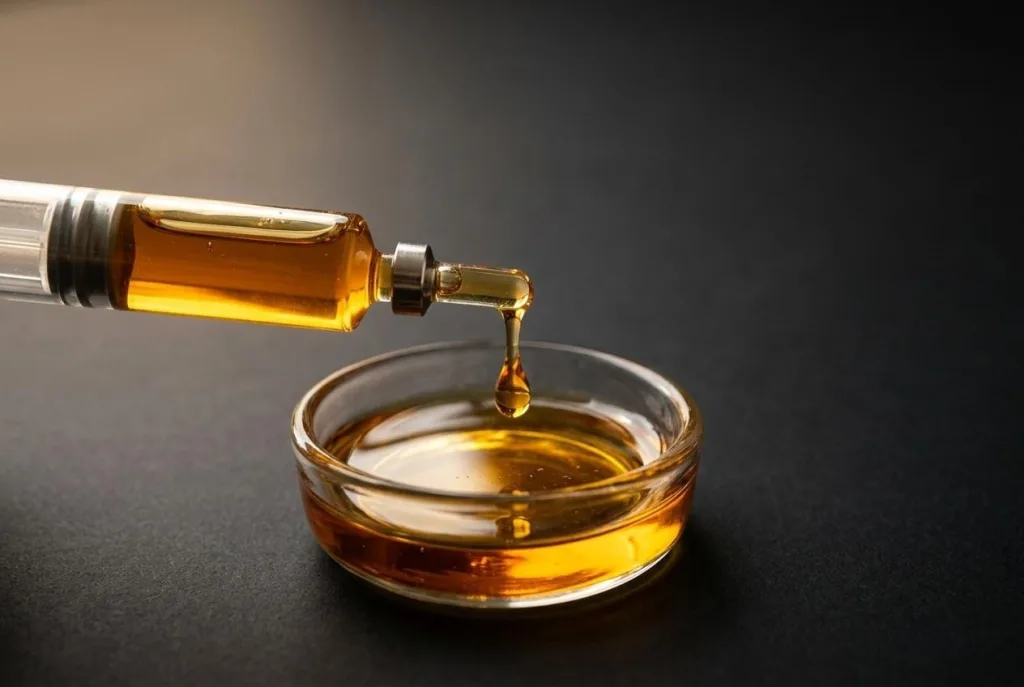
The process uses heat and a vacuum to vaporise the cannabinoids at specific temperatures, then collects and condenses them back into a liquid. Think of it like distilling alcohol, where you’re pulling one thing out of a complex mixture and concentrating it. The result is a thick, semi-clear to golden oil that’s extremely potent and almost completely odourless and flavourless on its own.
Because so much is removed, distillate is one of the highest-potency extracts you’ll come across. That said, it’s very different from something like live rosin or full-spectrum hash oil, which hold onto far more of the plant’s original character. If you want to understand where distillate fits in the bigger picture, our Cannabis Concentrates: The Complete Guide covers the full range.
How distillate is made (the short version)
Producers usually start by making a crude cannabis extract, often using CO2 or ethanol to pull the cannabinoids and other compounds out of the plant. That crude oil is then put through a couple of cleaning steps to remove chlorophyll and fats before it goes into a short-path or wiped-film distillation machine.
Inside that machine, the oil is heated under a vacuum (low pressure lowers the boiling point, so nothing burns). Different compounds boil off at different temperatures, so the operator collects the fraction that contains the target cannabinoid and leaves the rest behind. The output is a smooth, viscous oil that’s much purer than what they started with.
A second or third pass through the machine pushes purity even higher. More passes equals a cleaner product, though each pass also removes a little more of anything useful that might have been left.
Why does distillate taste like nothing?
Terpenes, the compounds responsible for a strain’s smell and flavour, boil off at lower temperatures than THC. So by the time distillation is done, most of them are gone. What’s left is nearly tasteless and odourless oil.
This is actually part of why distillate is so useful in manufactured products. It’s a blank canvas. Producers can add back in specific terpenes, flavours, or other ingredients and have full control over the final product. A vape cart labelled “Blue Raspberry” almost certainly has distillate plus added flavouring, not a naturally flavoured extract.
If you care about tasting the actual plant, distillate isn’t your answer. For that, you’d want something like live resin, rosin, or full-spectrum oil. Check out our breakdown of THCA Diamonds, which often get combined with terpene-rich sauce to deliver both potency and flavour in one product.
Where you’ll find distillate
Distillate is everywhere once you start looking for it. Vape cartridges are the most common home for it. The oil is thin enough to flow through a cart, potent enough to hit hard in small puffs, and flavourless enough to take on whatever terpenes or flavours get added. If you want to browse what’s available, our Shop Vapes & Disposables section has a solid selection.
Gummies and other edibles rely on distillate too. It blends into fats and sugars without fighting the other flavours, and producers can dose it accurately because its potency is so consistent. You can browse our Gummies & Edibles section to see what’s on offer.
Tinctures are another common use. Some tinctures, like MOTA’s Sleep Tincture (1000 mg THC / 150 mg Melatonin), use THC distillate as the active ingredient, made for sleep, and are designed to be taken sublingually or added to food or drink. CBD versions follow the same logic, MOTA’s CBD Sleep Tincture (1000 mg CBD / 150 mg Melatonin) is another example of distillate-based oil used in a finished product.
Distillate vs. other concentrates: a quick look
| Concentrate type | Terpenes kept? | Potency | Flavour | Common use |
|---|---|---|---|---|
| Distillate | Mostly no | Very high | Minimal (added back in) | Vapes, edibles, tinctures |
| Live resin | Yes | High | Strong, true-to-plant | Dabbing, vapes |
| Rosin | Yes | High | Rich, full | Dabbing, vapes |
| Full-spectrum oil | Yes | Moderate to high | Earthy, complex | Tinctures, capsules |
| Hash | Yes | Moderate to high | Rich, varies by type | Smoking, dabbing |
The short version: distillate wins on pure potency and versatility. Other concentrates win on flavour and keeping the full range of plant compounds together. Neither is objectively better; it depends on what you’re after.
Is distillate good for dabbing?
You can dab distillate, but most people who dab regularly don’t reach for it first. It’s very thick and sticky at room temperature, which makes loading a dab nail awkward. It also tastes like almost nothing, which takes away a big part of the appeal of dabbing for flavour chasers. People who dab usually prefer rosin, live resin, or something like sauce, where the terpenes are still intact and the flavour payoff is high.
That said, if raw potency is the only goal and you don’t mind the bland hit, distillate works fine. Start low, go slow.
Full-spectrum vs. distillate: does it matter?
You’ll often see “full-spectrum” on a product and wonder if it’s worth caring about. Full-spectrum means the extract kept a wide range of the plant’s cannabinoids and terpenes together. Some people find that full-spectrum extracts feel different from distillate, often described as a more rounded or complex effect, though this varies a lot from person to person. Distillate is closer to isolated THC or CBD on its own.
If you’re new to concentrates, distillate-based products (especially vapes and gummies) are usually the most predictable and straightforward. If you’ve been around the block and want more complexity, full-spectrum or rosin-based products are worth exploring. Our Cannabis Concentrates: The Complete Guide is a good place to figure out what fits your preferences.
Frequently asked questions
Is cannabis distillate the same as THC oil?
Not exactly, though the terms get used interchangeably a lot. THC oil is a broad term that can refer to any oil containing THC, including crude extracts or full-spectrum oils. Distillate is specifically oil that’s been through the distillation process to purify it. Most THC oil in vape carts is distillate, but not all THC oil is.
Does distillate get you higher than regular weed?
Potency-wise, distillate is much more concentrated than flower. A small amount goes a long way. That doesn’t automatically mean a “better” high, just a stronger one, and the experience feels different without the full range of terpenes and minor cannabinoids. Start low, go slow, especially if you’re new to concentrate products.
Why does my vape cart taste artificial?
Because the terpenes in distillate-based carts are usually added back in after processing, not naturally present from the plant. Producers use botanical terpenes (from other plants) or cannabis-derived terpenes to create flavour profiles. Neither is inherently bad, but it’s a different experience from something like a live resin or rosin cart where the flavour comes straight from the plant.
Can distillate be used in cooking?
Yes, and it’s actually one of the more practical ways to make cannabis edibles at home. Because it’s already been through decarboxylation (the heating step that activates THC) during processing, you don’t need to cook it further. It mixes well into fats like butter or coconut oil. As always, start low, go slow with any edible.
What’s the difference between distillate and isolate?
Distillate is a very pure oil but may still contain small amounts of other cannabinoids. Isolate takes it one step further, it’s the cannabinoid in its nearly pure crystalline or powder form, with virtually everything else removed. CBD isolate shows up in some products as a powder mixed into other ingredients. Distillate is oilier and easier to work with in most product formats.
Is distillate better than hash or rosin?
Better is the wrong word. Distillate is cleaner and more potent in terms of isolated THC or CBD content. Hash and rosin keep far more of the plant’s terpenes and minor cannabinoids, so many people find the experience richer or more satisfying despite sometimes being lower in raw THC percentage. It’s a different tool for a different goal. If you want to dig into what makes hash and rosin special, our guides on What Is Hash? and the broader concentrates world are worth your time.